
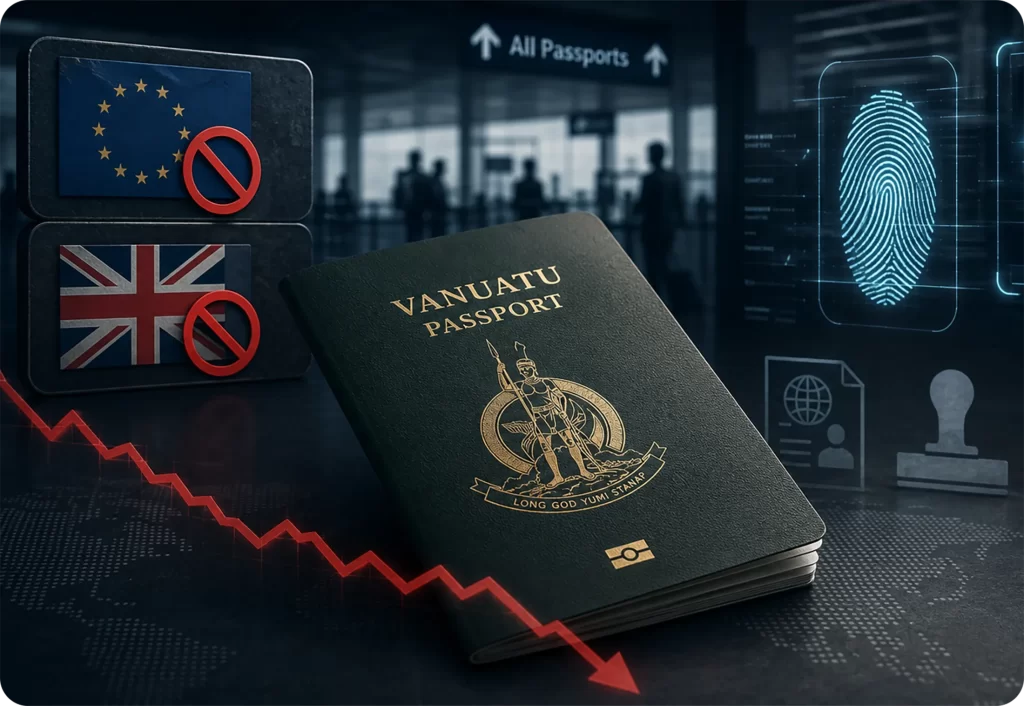
Executive Summary: The Structural Shift of a Fast-Track Passport
Vanuatu has historically been a popular fixture in the investment migration industry, celebrated as the fastest fully remote citizenship program in the world. For a non-refundable contribution starting at $130,000, investors could secure a secondary passport in under 60 days without ever visiting the South Pacific island nation.
However, the international landscape has dramatically tightened around Vanuatu. Following permanent visa suspensions by Western nations and internal security overhauls, the utility of the passport has changed. Today’s holders face major mobility roadblocks and unprecedented banking scrutiny.
The 4 Major Difficulties Facing Vanuatu Passport Holders Today
1. Total and Permanent Loss of EU Schengen and UK Access
The most damaging setback for Vanuatu passport holders is the complete loss of its primary global mobility drivers.
- The Schengen Ban: Following a multi-year temporary suspension, the Council of the European Union formally moved Vanuatu to its permanent visa-required list. Holders traveling to any of the 29 Schengen Area states must now go through the standard, bureaucratic consular visa application process.
- The UK Block: Operating independently, the United Kingdom also permanently revoked visa-free entry for Vanuatu nationals. This double-blow strips the passport of its European travel utility, reducing its total visa-free count to roughly 88 destinations.
2. Severe Private Banking Scrutiny and Onboarding Rejections
Holding a Vanuatu CBI passport has become an immediate “red flag” across major global financial hubs.
- The AML Trap: Due to historical concerns flagged by the Financial Action Task Force (FATF), international compliance teams routinely classify Vanuatu economic citizens as high-risk clients.
- Account Closures: Wealth management institutions and private banks across Singapore, Hong Kong, and Dubai have drastically increased rejection rates for account openings tied to Vanuatu documentation. Holders face invasive audits regarding their true tax residency and original source of wealth.
3. Strict New Mandatory In-Person Biometrics
The era of a 100% remote, hands-off application and renewal process for Vanuatu has officially ended.
- The Physical Mandate: To comply with international civil aviation and security standards, the Vanuatu Citizenship Commission (VCC) enacted a strict requirement forcing all passport holders and applicants to provide biometrics in person.
- Logistical Friction: Holders seeking to renew expiring passports or finalize new files must now travel directly to Vanuatu or coordinate visits to a highly limited network of designated overseas consular offices. This introduces unexpected travel costs and logistical planning for busy business owners.
4. Heightened Scrutiny on Tax Residency and CRS Reporting
Vanuatu’s historical appeal as a zero-tax haven is undergoing aggressive international regulatory exposure.
- CRS Integration: Under pressure from global regulatory bodies, Vanuatu has stepped up its execution of the Common Reporting Standard (CRS), rolling out Tax Identification Numbers (TINs) to cross-reference economic citizens.
- Reverse Reporting: Foreign banks now aggressively reverse-report account balances back to an investor’s country of original residence or primary economic activity, heavily diminishing the passport’s effectiveness for low-profile asset protection.
Mobility Comparison: Global Access Trajectory
| Era / Status | Visa-Free Countries Accessible | Key Accessible Regions Included |
| Pre-2022 Baseline | 130+ Destinations | UK, EU Schengen, Singapore, Hong Kong |
| Current 2026 Reality | ~88 Destinations | Singapore, Hong Kong, Malaysia, Select LatAm |
| Major Deficits | Schengen & UK Restricted | Requires formal advanced visa clearance |
Conclusion: Realignment as a Narrow Backup Tool
The Vanuatu passport is no longer a tool for seamless global mobility. However, it is not entirely obsolete. It remains an incredibly fast, legal secondary identity that serves as an effective emergency backup plan, a family contingency file, or a gateway to non-European business hubs like Singapore and Hong Kong. Investors must simply evaluate the tool based on what it can actually achieve, rather than outdated travel expectations.